For experienced Jeep owners, swapping out sway bar links, steering stabilizers, or basic rear shock absorbers on solid-axle models like the 2026 Jeep Wrangler is entirely manageable in a home garage with basic hand tools. However, complex components like front strut assemblies, ball joints, control arms, and pneumatic air springs require specialized spring compressors, hydraulic presses, and mandatory four-wheel alignment equipment best left to certified technicians. Today, Steve Ross, Service Manager at Hawkins Chrysler Dodge Jeep Ram with 15 years of hands-on automotive expertise, breaks down what owners need to know about Jeep suspension care, realistic service costs, and maintenance strategies.
Q: Which Jeep suspension repairs are reasonably DIY-friendly for experienced owners?
A: Replacing components like sway bar end links, steering stabilizers, and standard direct-fit rear shock absorbers on a solid-axle platform like the 2026 Jeep Wrangler is easily within reach for an experienced home mechanic. These components are accessible, held by standard hardware, and do not require compressing heavy coil springs or disconnecting critical steering linkages. Installing a fresh steering stabilizer or unbolting worn sway bar links can eliminate minor front-end rattles and tighten up handling in a single afternoon using standard socket sets and torque wrenches.
When you start looking at front strut assemblies on independent front suspension models, ball joints, pressed control arm bushings, or electronic air suspension components, the DIY equation changes drastically. Compressing heavy-duty coil springs without commercial equipment poses severe safety risks, while replacing control arms or ball joints alters steering geometry enough that driving without an immediate four-wheel alignment will destroy a set of tires in short order. If you ever feel unsure about tackling a suspension project at home, you can drop by our Montour Boulevard service center or give our service desk a quick call to consult with our master technicians.
Q: How much does Jeep suspension replacement or repair typically cost overall?
A: Total Jeep suspension repair bills vary widely depending on whether you are replacing a single wearable component or overhauling an entire axle. Minor repairs, such as replacing a worn sway bar link or a steering stabilizer, generally cost between $75 and $250 including parts and shop labor. Individual shock absorber or strut replacements typically range from $300 to $800 per axle for standard conventional systems, while complete front and rear suspension overhauls or major control arm and ball joint work can run anywhere from $1,200 to $2,500.
Vehicle architecture and local driving conditions play a major role in these cost variations. Heavy-duty 4x4 models equipped with solid front and rear Dana axles utilize heavy-duty linkage bars and track bars that take significant trail abuse. Furthermore, winter road salt across central Pennsylvania causes chassis hardware to seize, often requiring extra labor time to safely extract rusted bolts during component swaps. When budget planning, always account for shop labor rates, hardware replacement, and a mandatory post-repair wheel alignment to preserve tire life.
Q: What is the typical shock or strut replacement cost for a 2026 Jeep?
A: Replacing a pair of standard gas-charged shock absorbers or complete strut assemblies on a 2026 Jeep Wrangler or 2026 Jeep Grand Cherokee generally totals between $479 and $679 per axle for factory-spec parts and professional installation. Parts costs usually account for $340 to $485 of that estimate, while labor runs approximately $135 to $200 per axle depending on model complexity. High-performance trims equipped with aluminum reservoir shocks or upgraded off-road dampers fall into a higher price bracket, where parts alone can exceed $800 to $1,600 per axle.
"Owners who bring their Wrangler in after weekend trail rides near Danville usually ask about front-end clunks before we even get the rig on the lift."
Labor duration typically averages one to two hours per axle for direct shock replacements on solid axles, whereas front strut assemblies on independent suspension setups require two to three hours plus an additional 30 to 45 minutes for a full computerized wheel alignment. Replacing shocks and struts in pairs across the same axle is essential for safety, as mismatched damping performance creates uneven weight transfer during hard braking and high-speed cornering.
Q: Why is air or active suspension repair on a Jeep Grand Cherokee more expensive than standard suspension?
A: Active pneumatic systems like the Quadra-Lift air suspension available on the 2026 Jeep Grand Cherokee rely on complex closed-loop networks consisting of air bladders, an electric compressor, solenoid valve blocks, height sensors, and pressurized nitrogen lines. When a traditional coil spring system fails, you simply swap a mechanical steel spring or shock absorber. In contrast, an air suspension leak requires specialized diagnostic software to pinpoint pressure drops, followed by replacing components where individual air spring assemblies often cost over $1,600 in parts alone.
Replacing an active air spring or air strut typically pushes total repair estimates to between $1,852 and $1,932 per corner when factoring in technical labor and system recalibration. The service procedure requires completely deactivating the pneumatic system, purging high-pressure gas, installing the replacement air bag unit, and using factory diagnostic tablets to perform an electronic height re-calibration. Ignoring a leaking air spring also forces the air compressor to run continuously, which quickly burns out the pump motor and doubles the ultimate repair bill.
Q: What is included in a typical Jeep suspension service?
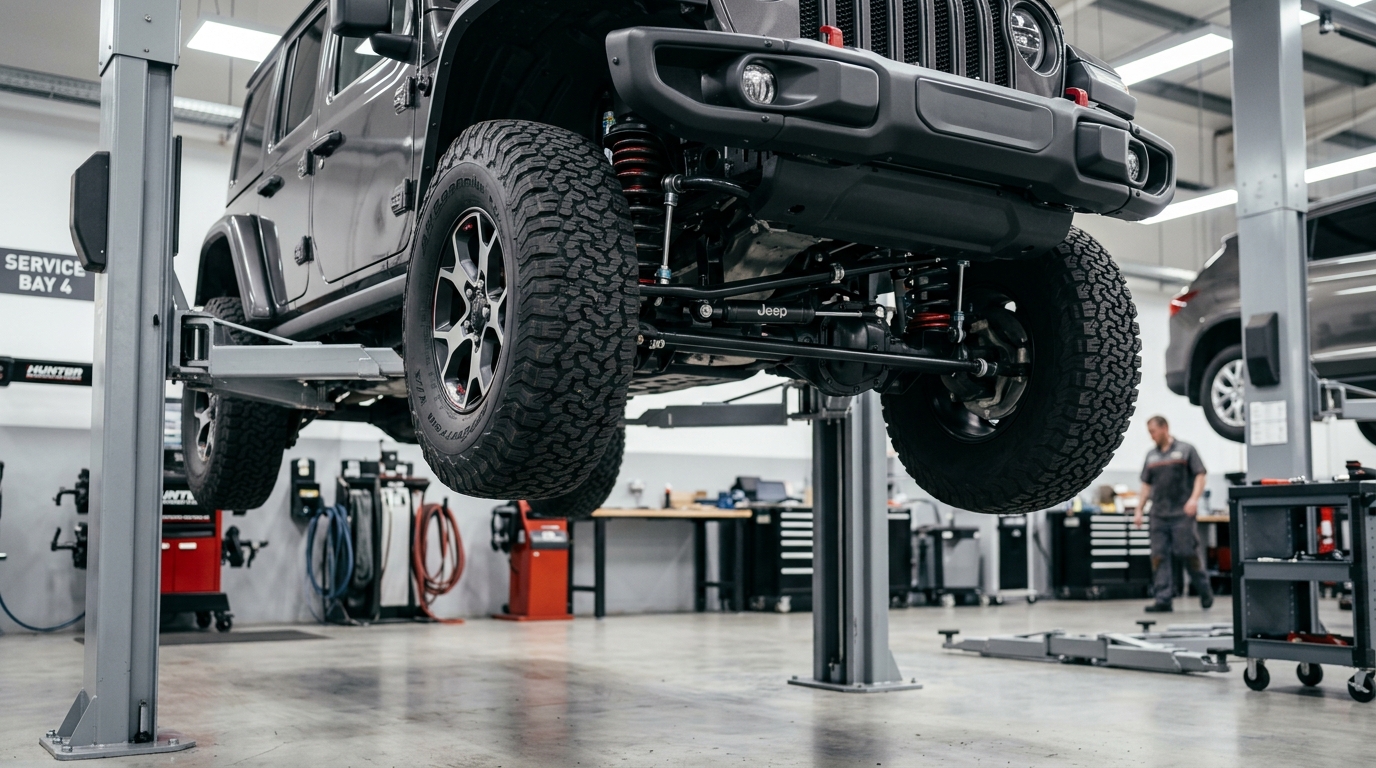
A: A comprehensive Jeep suspension service begins with an extensive visual and mechanical inspection on a vehicle lift, where technicians examine shock absorbers and struts for hydraulic oil leaks, structural cracks, or damaged rubber boots. We check every control arm bushing, track bar mount, tie rod end, and ball joint for excessive play using pry bars and dial indicators to ensure tolerances remain within factory limits.
Following the mechanical check, technicians inspect steering dampeners, sway bar end links, and coil springs for rust or sagging, while air-suspension models undergo an electronic leak test of all pneumatic lines and valve blocks. The service concludes with a road test to evaluate ride stability over real-world road imperfections, followed by mounting the vehicle to a digital alignment rack to measure camber, caster, and toe angles.
Q: How often should Jeep suspension be inspected as part of regular maintenance?
A: Factory maintenance guidelines direct technicians to perform a visual suspension and steering inspection at every oil change interval, or roughly every 5,000 to 7,500 miles. Dedicated suspension checks—focusing closely on shock damping, ball joint wear, and track bar torque—should occur every 15,000 to 20,000 miles for street-driven vehicles. Commuters navigating daily pothole impacts on river valley routes near Bloomsburg should stick strictly to these 15,000-mile intervals to catch joint looseness before it damages surrounding components.
For Jeeps that frequently tackle off-road trails, rock crawling, or deep water crossings, inspection intervals should be cut in half. Off-road articulation puts extreme lateral stress on track bar bushings and control arms, while mud and sand act as abrasive paste that degrades rubber grease boots. Performing routine alignment checks every 20,000 miles—or immediately following a hard bottom-out event on the trail—prevents irregular tread cupping and protects high-value steering boxes from premature failure.
Q: What can Jeep owners do to keep suspension repair costs under control?
A: The most effective way to minimize long-term suspension expense is to catch component wear early through routine inspections and perform minor preventative steps like washing undercarriage salt after winter driving. Replacing a $75 sway bar link or a soft $40 bushing as soon as it begins rattling prevents uneven forces from damaging expensive control arms, tie rods, or tires. Practicing smooth driving habits over rough railroad tracks and slowing down for deep potholes reduces high-impact hydraulic spikes inside shock absorbers.
When major repairs become necessary, choosing heavy-duty OEM Mopar components ensures proper fitment and long-term durability, preventing repeated labor charges for premature aftermarket part failures. For drivers balancing service budgeting alongside household vehicle needs, exploring our new vehicle options can offer factory warranty coverage that eliminates out-of-pocket repair worries altogether. To get expert eyes on your vehicle's undercarriage, schedule your next checkup through our Danville service department or reach out to our service team at (570) 275-3300 today.
© 2026 Hawkins Chrysler Dodge Jeep Ram. All rights reserved.