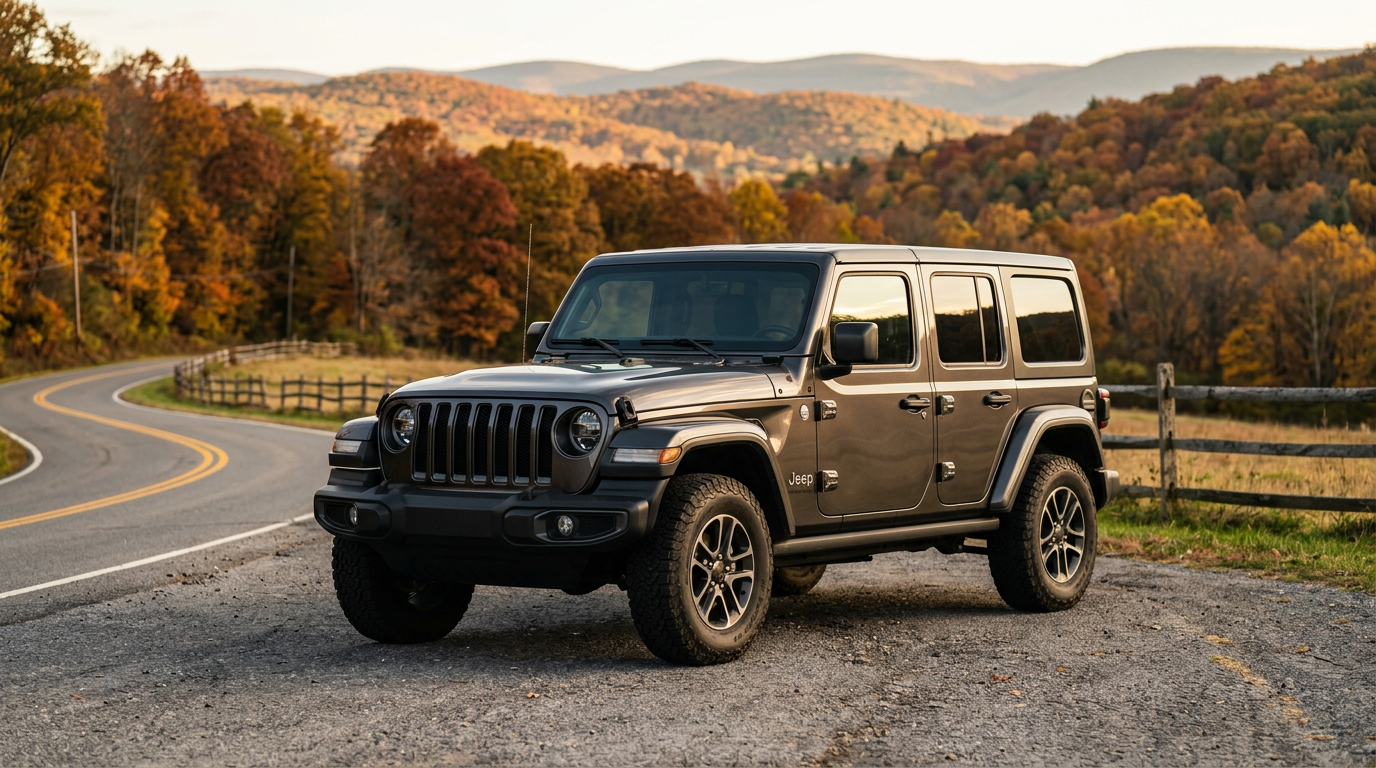
 A used Jeep Wrangler holds its resale value significantly better than most traditional midsize SUVs, retaining approximately 60% to 65% of its original sticker price after five years of ownership. Driven by a dedicated enthusiast community, iconic open-air styling, and unmatched off-road capability, the Wrangler experiences much slower depreciation than typical family crossovers, which often lose 50% or more of their original value over the same timeframe.
This strong value retention means pre-owned Wrangler buyers preserve a larger portion of their initial investment over time. When you decide to trade in your vehicle down the road, high residual values translate directly into higher trade-in allowances and lower total cost of ownership. Long-term demand remains resilient across both 2-door and 4-door configurations because the vehicle's body-on-frame design and solid axle layout appeal to buyers seeking authentic adventure utility.
While competitive off-road models like the Ford Bronco and Toyota 4Runner also perform well in national residual rankings, the Jeep Wrangler continues to stand out due to its extensive aftermarket support and timeless exterior aesthetic. Higher trims equipped with locking differentials and upgraded transfer cases—such as the Rubicon or Willys—tend to command higher market values on the used market even with higher odometer readings.
To see how much your current car, truck, or SUV is worth toward a pre-owned Wrangler, you can quickly evaluate your vehicle using our instant trade-in valuation tool. When you are ready to explore our pre-owned selection in person, visit our dealership at 1965 Montour Blvd in Danville or give our team (570) 275-3300 to schedule a test drive.
Table of Contents
- What Are the Structural and Engine Differences Between Jeep Wrangler JK and JL Models?
- Is a Used Ford Bronco a Better Purchase Than a Used Jeep Wrangler?
- How to Inspect a Used Jeep Wrangler Frame for Rust, Salt Damage, and Concealed Repairs
- What Signs Indicate That a Used Jeep Wrangler Transmission Is Slipping or Failing?
- How Do You Test Transfer Case Engagement in 4H and 4L During a Test Drive?
- Does Pennsylvania Require Emissions Testing for Used Vehicles?
- Frequently Asked Buyer Questions About Pre-Owned Jeep Wranglers
- Take Your Next Step with Hawkins Chrysler Dodge Jeep Ram
What Are the Structural and Engine Differences Between Jeep Wrangler JK and JL Models?
The Jeep Wrangler JL generation represents a major structural and mechanical evolution over the preceding JK platform, introducing lightweight aluminum body panels, updated frame geometry, and modernized drivetrain options. While the JK generation (produced from 2007 to 2018) relied primarily on steel body construction, the JL generation (introduced for the 2018 model year) incorporates high-strength aluminum in the doors, hood, tailgate, and windshield frame to reduce curb weight and improve overall efficiency.
Underneath the bodywork, key chassis and powertrain differences set the two generations apart:
- Structural updates: The JL chassis features a hydroformed high-strength steel frame that improves stiffness while shaving off structural weight. The front windshield on JL models folds down easily by removing just four bolts, whereas the JK required removing 28 bolts and disassembling windshield brackets.
- Engine options: Early JK models utilized a 3.8L V6 rated at 202 hp before upgrading to the 3.6L Pentastar V6 delivering 285 hp and 260 lb-ft of torque for 2012. The JL carries forward the 3.6L Pentastar V6 but adds an optional 2.0L turbocharged 4-cylinder generating 270 hp and 295 lb-ft of torque, alongside the plug-in hybrid 4xe powertrain delivering 375 hp.
- Transmission technology: The JK generation utilized a 5-speed automatic or 6-speed manual transmission. The JL upgraded to a smooth-shifting 8-speed automatic transmission or a revised 6-speed manual transmission, providing better highway fuel economy and broader gear ratios for low-speed rock crawling.
- Interior and safety: JL models introduced standard side curtain airbags, an updated dash structure, and modern infotainment displays up to 12.3 inches.
For shoppers evaluating both generations, the JL offers noticeably improved steering response via an electro-hydraulic steering setup compared to the JK's traditional hydraulic box. If you are interested in exploring the newest iterations of this legend, take a look at our new Jeep Wrangler inventory to review standard features across current trim levels.
Is a Used Ford Bronco a Better Purchase Than a Used Jeep Wrangler?
Choosing between a used Ford Bronco and a used Jeep Wrangler comes down to your personal balance of daily highway driving comfort versus solid-axle off-road durability. The Ford Bronco features an independent front suspension that provides smoother, more car-like steering control on paved highways. Conversely, the Jeep Wrangler retains solid Dana 44 front and rear axles on off-road trims, providing superior wheel articulation over rocky terrain and unmatched durability for severe off-roading.
The Wrangler also holds a significant advantage in aftermarket flexibility and long-term ownership ecosystem. Decades of production mean replacement parts, specialized suspension lifts, metal bumpers, and soft-top options are widely available and often more affordable for the Wrangler than for the Bronco. In towns like Franklin Township, where drivers transition daily between paved suburban roads and unpaved back-country trails, the Wrangler's customizable setup lets owners tailor their vehicle precisely to local driving needs.
From a practical capability perspective, both vehicles deliver standard four-wheel drive and removable doors and roofs. However, the Wrangler offers a broader variety of engine options across used inventory, ranging from fuel-efficient turbocharged four-cylinders to high-output V8 options like the Rubicon 392 with 470 hp and 470 lb-ft of torque. The four-door Wrangler Rubicon with the proper tow package can tow up to 5,000 lb, matching or exceeding typical midsize SUV ratings.
Our sales team regularly assists buyers comparing these two legendary off-roaders on our lot. You can explore our featured pre-owned vehicle inventory to see available pre-owned Wranglers, or apply online to prequalify for auto financing online before scheduling your visit.
How to Inspect a Used Jeep Wrangler Frame for Rust, Salt Damage, and Concealed Repairs
Inspecting the frame of a used Jeep Wrangler is the most critical step when shopping for a pre-owned 4x4 in regions exposed to winter road treatments. Road salt and moisture accumulate inside the boxed frame channels, causing rust to form from the inside out. Without a thorough hands-on inspection, severe internal frame corrosion can go unnoticed underneath a clean body.
Follow this systematic inspection process when examining a candidate vehicle:
- Check torque boxes and body mounts: Inspect where the frame rails meet the body mounts directly behind the front wheels and in front of the rear wheels. Flaking metal or heavy rust scales in these locations signal structural weakness.
- Examine control arm attachment points: Look closely at the brackets where the front and rear control arms weld to the frame. Heavy rust around these high-stress welds can lead to dangerous suspension failure.
- Inspect skid plate mounting points: The transmission skid plate attaches directly to the bottom of the frame rails. Trapped dirt and salt often cause the frame belly to rot out around these bolt holes, making it impossible to secure protection plates.
- Perform the tap test: Use a small screwdriver or mechanic's hammer to gently tap along the lower frame rails and near drain holes. Solid frame steel produces a clear metallic ring, while rusted or thin metal sounds dull and hollow.
- Detect covered-up rust: Be cautious if you observe fresh black rubberized undercoating or paint sprayed over textured, flaking surfaces. Dishonest sellers sometimes spray undercoating directly over rust without properly repairing the degraded metal underneath.
Minor surface rust can be cleaned, neutralized, and sealed for a few hundred dollars. However, severe structural rot requiring welded frame repair caps or full section replacements can easily cost thousands. Thoroughly inspecting the frame underside before finalizing your purchase ensures your vehicle remains safe and roadworthy for years.
What Signs Indicate That a Used Jeep Wrangler Transmission Is Slipping or Failing?
Detecting transmission issues early during a pre-owned vehicle inspection helps avoid costly drivetrain repairs down the road. Whether you are evaluating a 6-speed manual or an 8-speed automatic Wrangler, pay close attention to how the gearbox responds under load and across operating temperatures.
Key warning signs of transmission slippage or mechanical failure include:
- Delayed gear engagement: Pauses or hesitation when shifting the selector from Park into Drive or Reverse indicate low fluid pressure or internal clutch wear.
- Unexplained engine flare: If engine RPM increases noticeably while accelerating but vehicle speed does not increase proportionally, the automatic transmission clutches are slipping.
- Harsh or clunky shifts: Hard thumps or aggressive jarring when upshifting or downshifting between gears indicate valve body faults or degraded transmission fluid.
- Burnt fluid odor or dark color: Fluid that appears dark brown or smells burnt points to severe thermal overheating and burnt internal friction plates.
- Gear pop-out on manual models: On manual Wranglers, popping out of gear while cruising indicates worn synchronizers, damaged shift forks, or worn transmission mounts.
During your test drive, take the vehicle through a complete drive cycle that includes low-speed stop-and-go driving as well as highway acceleration. If the transmission hunts for gears continuously on mild inclines or hesitates under hard throttle, have the vehicle inspected by qualified technicians before buying.
How Do You Test Transfer Case Engagement in 4H and 4L During a Test Drive?
Testing four-wheel-drive transfer case engagement is an essential part of evaluating any used Jeep Wrangler. A healthy transfer case should shift smoothly between two-wheel drive high ( 2H), four-wheel drive high ( 4H), and four-wheel drive low ( 4L) without binding or grinding. Always conduct four-wheel-drive testing on loose surfaces such as gravel, dirt, or snow to prevent driveline binding on dry pavement.
Our sales team notes that buyers test-driving a pre-owned Wrangler almost always ask how to properly shift the transfer case into 4H and 4L before taking it out on the road.
To test transfer case operation correctly:
- Shift into 4H (Four-Wheel Drive High): While coasting straight ahead at 10 to 25 mph on an unpaved road—such as dirt paths near Riverside—pull the transfer case lever firmly back from 2H into 4H. The shift should occur smoothly without grinding. Confirm that the dashboard 4WD indicator light illuminates and check that steering effort remains normal without heavy pulling.
- Shift into Neutral for 4L: Bring the vehicle to a slow roll between 1 and 3 mph. Shift the main transmission into Neutral.
- Shift into 4L (Four-Wheel Drive Low): With the vehicle barely rolling in Neutral, pull the transfer case lever firmly through Neutral straight down into 4L in one swift movement. Do not pause in transfer case Neutral, as doing so can cause gear grinding.
- Verify Low-Range Operation: Shift the main transmission back into Drive (or 1st gear on a manual) and apply light throttle. In 4L, engine revs will be significantly higher and vehicle speed will be low, demonstrating gear reduction for steep climbs or heavy pulling.
- Return to 2H: Stop the vehicle, shift the main transmission to Neutral, pull firmly out of 4L into 4H, and then push forward into 2H before returning to paved roads.
If the transfer case lever feels completely stuck, makes loud popping sounds under load, or pops out of 4WD mode automatically, internal linkage adjustment or transfer case repair is necessary.
Does Pennsylvania Require Emissions Testing for Used Vehicles?
Pennsylvania emissions inspection requirements depend on the county where your vehicle is registered rather than where you purchase or service it. Commonwealth regulations divide Pennsylvania's 67 counties into designated emissions regions and non-emissions counties.
In Montour County, vehicles are not subject to annual electronic OBD-II emissions analyzer testing. Instead, vehicles registered here undergo a mandatory annual safety inspection that includes a Visual Anti-Tampering Check of emission control components and a gas cap leakage test. Certified inspection stations verify that key factory items—such as the catalytic converter, exhaust manifold, evaporative canister, and gas cap—are present and uncompromised.
If you live in or re-register your vehicle in one of Pennsylvania's 25 designated emissions counties (such as nearby Lycoming or Luzerne counties), gasoline-powered vehicles from model year 1996 and newer under 8,500 lbs GVWR must pass an annual OBD-II electronic emissions check alongside their safety inspection. Exemptions apply for brand-new vehicles in their first year with under 5,000 miles, as well as low-mileage vehicles driven fewer than 5,000 miles in the previous 12 months under single ownership.
At Hawkins Chrysler Dodge Jeep Ram, every pre-owned vehicle on our lot undergoes a thorough multipoint inspection to ensure full compliance with Pennsylvania safety standards. Stop by our Danville showroom address, browse our current selection of vehicles under $40,000, or give our friendly team a call at (570) 275-3300 to discuss your next vehicle purchase.
Frequently Asked Buyer Questions About Pre-Owned Jeep Wranglers
Q: What is considered high mileage for a used Jeep Wrangler?
Because of their heavy-duty ladder frame and durable solid axles, a well-maintained Jeep Wrangler can comfortably pass 200,000 miles. A pre-owned Wrangler with 100,000 miles that has regular maintenance records and a clean frame is often a better purchase than a lower-mileage vehicle with severe rust or off-road damage.
Q: Which engine is best in a pre-owned Jeep Wrangler?
The 3.6L Pentastar V6 is widely regarded as one of the most reliable and proven engines in the Wrangler lineup, delivering 285 hp and easy maintenance. The 2.0L turbocharged 4-cylinder offers more low-end torque with 295 lb-ft for quick acceleration around town, making both options strong choices depending on your driving style.
Q: Should I buy a 2-door or 4-door used Jeep Wrangler?
The 2-door Wrangler features a shorter wheelbase that excels on tight off-road trails and is easier to park. The 4-door Wrangler Unlimited provides significantly more rear legroom, easier access for rear passengers, and expanded rear cargo space, making it much more practical for families and daily commuting.
Q: What documents should I bring to the dealership when buying a used Wrangler?
Bring your current valid driver's license, up-to-date auto insurance card, payment or trade-in title if applicable, and recent pay stubs if completing a credit application. Having these documents ready speeds up the purchasing process so you can drive home smoothly.
Q: Can a used Jeep Wrangler be flat-towed behind a motorhome?
Yes, four-wheel-drive Jeep Wranglers equipped with a manual transfer case can be flat-towed with all four wheels on the ground. Placing the transfer case in Neutral allows flat towing without accumulating odometer mileage or damaging the transmission.
Take Your Next Step with Hawkins Chrysler Dodge Jeep Ram
Whether you are looking for an adventure-ready pre-owned Wrangler or evaluating your current vehicle's trade-in value, our team is here to provide transparent guidance and flexible financing solutions tailored to your budget. Visit Hawkins Chrysler Dodge Jeep Ram today to browse our extensive inventory, test drive your favorite models, and experience our consultative approach firsthand.
© 2026 Hawkins Chrysler Dodge Jeep Ram. All rights reserved.